Anisotropy & the OM–vs–Michie formalism (B6)
Velocity anisotropy is encoded in the Binney anisotropy — zero for isotropic orbits, rising toward 1 for radially-biased ones — and parametrized by an anisotropy radius . This demo asks two questions: how well can be measured, and does it matter which anisotropy formalism you assume?
Inputs and assumptions
The fit recovers one parameter, the anisotropy radius — but always under the assumed OM formalism. Part (b) makes the point that this assumed model form is itself the load-bearing input: fit the wrong formalism and is biased.
Table 1:Model inputs
Input | Meaning and role | Status (fiducial) |
|---|---|---|
Osipkov–Merritt anisotropy radius — the science target; sets where orbits turn radial via . | recovered (1.5 pc; part (b) truth 6.0 pc fit under the wrong model) | |
anisotropy model form | The assumed fit model — the load-bearing choice that part (b) deliberately violates. | known / fixed (model assumption) |
/ , | Plummer half-mass radius (1 pc) for part (a); King , pc for the part-(b) Michie cluster — concentration/scale held at truth. | known / fixed |
masses, | Equal-mass tracers (1 ); (STELLAR) threaded into velocity sampling. | known / fixed |
, bins, occupancy, box, MLE, -SE | stars; 18 log radial bins (min 80/bin); pc; 500 Adam steps; conservative per-bin error . | numerical choices |
(a) Well-specified: recovering Osipkov–Merritt 
The Osipkov–Merritt (OM) ansatz Merritt, 1985 makes the DF a function of , giving the closed-form profile
A Plummer+OM cluster (, true pc) is sampled, binned, and recovered by a fit of (1):
quantity | truth | recovered |
|---|---|---|
1.5 pc | pc (pull +1.49) |
The OM form fits an OM cluster well (reduced ; the conservative error deflates it), and the Fisher forecast gives . Anisotropy this strong () is detectable in a modest sample.
(b) Misspecified: an OM fit to a Michie cluster
Anisotropy comes in different formalisms. The Michie (1963) anisotropic-King DF Michie, 1963
is not a function of a single , so its shape differs from (1). Sampling a Michie cluster (, true pc) and fitting it with the OM form:
quantity | value |
|---|---|
OM-fit | pc (vs true Michie ) |
OM-fit reduced | 5.58 — a 12.9× inflation over the well-specified fit |
So assuming the wrong anisotropy formalism does two things: it mis-estimates the anisotropy radius, and it leaves a systematic residual (the inflation) that detects the mismatch. The anisotropy model you assume shapes what you infer — anisotropy is not a single number read off independent of the DF family.
Figure
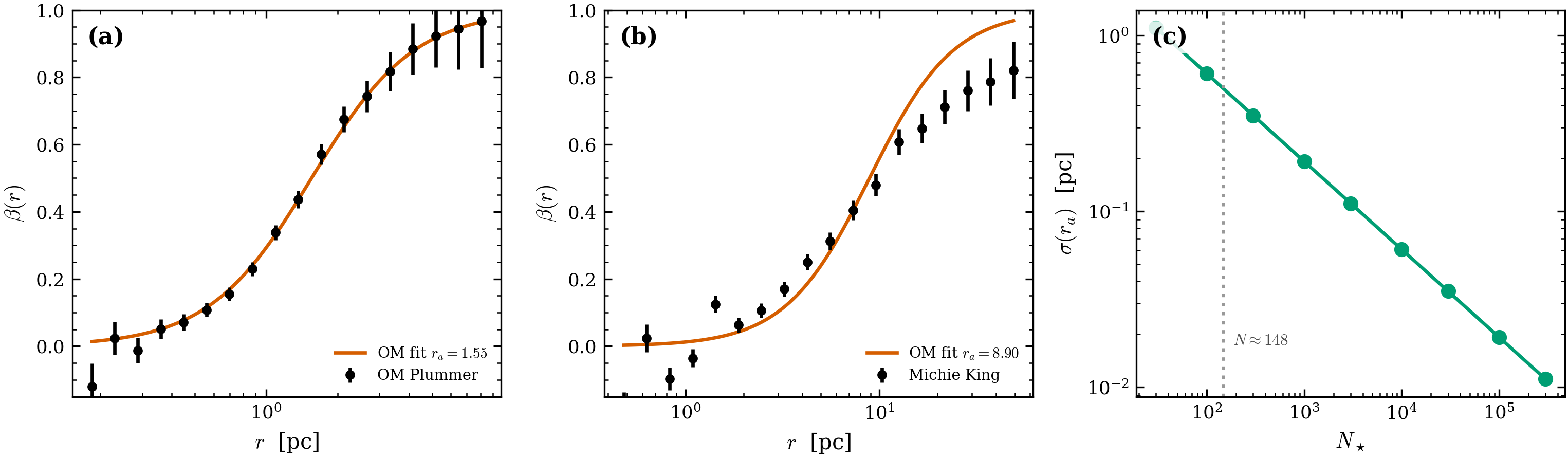
Figure 1:Anisotropy & the OM–vs–Michie formalism (scripts/demo_anisotropy.py, ALL
PASS). (a) A Plummer+OM cluster: (points, conservative errors) with
the recovered OM fit — a good match (reduced ). (b) A Michie
cluster fit with the OM form: the OM curve cannot follow the Michie
shape (reduced , worse), and the best-fit
mis-locates the true 6.0. (c) Forecast: for the
well-specified OM case.
Caveats
How to run
env -u VIRTUAL_ENV uv run --no-sync python scripts/demo_anisotropy.pyReferences
Osipkov–Merritt anisotropy is Merritt (1985); the Michie anisotropic-King DF is Michie (1963). The OM and Michie velocity DFs are documented on the anisotropy and rotation page; B3’s two-component OM recovery is at halo + core.
- Merritt, D. (1985). Spherical stellar systems with spheroidal velocity distributions. The Astronomical Journal, 90, 1027–1037. 10.1086/113810
- Michie, R. W. (1963). On the distribution of high energy stars in spherical stellar systems. Monthly Notices of the Royal Astronomical Society, 125, 127–139. 10.1093/mnras/125.2.127