A cluster’s tidal (Jacobi) radiusrt marks where the Galaxy strips stars,
and it is written in the outskirts — the sparse, count-limited edge of the
density profile. This stretch demo reuses the Poisson number-density channel
(B11) to recover rt from those few outer stars, and
turns it into the cluster’s Galactocentric distance.
The Elson–Fall–Freeman (1987) Elson et al., 1987 profile
ρ(r)=(1+r2/a2)−γ/2 is sharply truncated at rt. The scale
radius a is pinned by the inner profile (where almost all the stars are), so
it is held fixed; rt is read from the outer counts. Bins are placed out past
rt so the outermost are empty: a too-large rt predicts stars in those empty
bins (penalized by the Poisson −μ term), a too-small rt cannot explain the
observed outer stars. The Poisson channel is honest there; a Gaussian-on-log-count
would be ill-defined. (A steep halo self-truncates — its density at rt is
already ∼0, so rt sits in the noise; this uses a shallow, YMC-typical
γ=2.5 so stars reach rt.)
The fit recovers one parameter, the truncation/tidal radius rt; the scale
radius, the profile family, and both masses in the Jacobi conversion are assumed
known. The mass assumptions matter most — they, not the count statistics, would
dominate a real Rgal error budget.
EFF truncation = Jacobi/tidal radius — the science target, read from the count-limited outer bins and converted to Rgal.
recovered (12.0 pc)
a
EFF scale radius; pinned by the inner profile and held fixed (jointly fitting (a,rt) from counts is degenerate).
known / fixed (1.0 pc)
γ
EFF outer slope; shallow enough that stars reach rt (a steep γ self-truncates and hides rt).
known / fixed (2.5)
Mgal
Interior Galaxy (point-mass) for the Jacobi →Rgal conversion.
known / fixed (5×10¹⁰M⊙)
Mcl
Cluster mass entering Rgal=rt(3Mgal/Mcl)1/3 — summed from the IMF draw, treated as exactly known.
known / fixed (∼104M⊙, derived)
IMF
Maschberger (α=2.3, 0.08–100M⊙) — fixes Mcl; the mass spectrum does not enter the count fit (positions only).
known / fixed
N, bins, rhi factor, boxes, MLE
2×10⁴ stars; 22 geometric bins from rlo=0.2 pc to 1.3rt (so outer bins are empty — the Poisson −μ term is what pins rt); 3000-pt cumulative-EFF grid; rt∈(6,18) pc; 3 Adam starts.
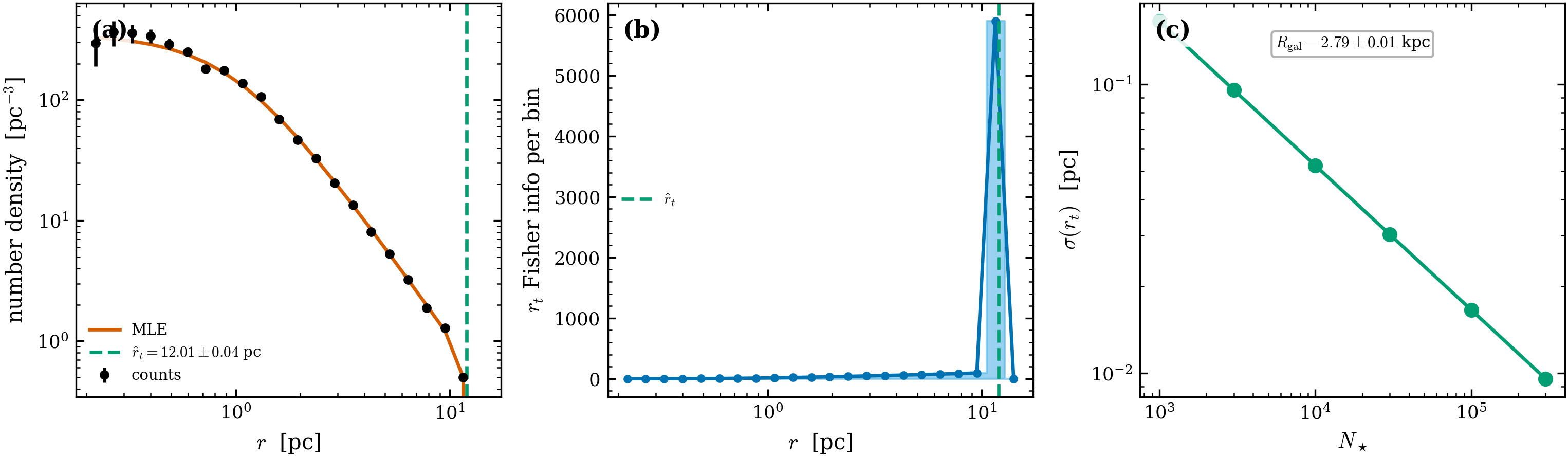
The per-bin Fisher information spikes at the truncation edge (panel b): rt is
constrained almost entirely by the handful of outermost bins, which is precisely
why the Poisson treatment of those low-count bins matters.
Figure 1:Tidal radius from the outskirts (scripts/demo_tidal_radius.py, ALL PASS).
(a) The EFF number-density profile (counts, N errors) with the MLE fit
and the recovered truncation r^t. (b) The per-bin Fisher information for
rt on a log-r axis: it spikes at the truncation edge — 93% of the
constraint comes from the count-limited outskirts. (c) Forecast
σ(rt)∝N−1/2, annotated with the derived Galactocentric distance.
The EFF profile is Elson et al. (1987); the tidal/Jacobi radius is
King (1962). The Jacobi-radius derivation and progenax’s
apply_tidal_truncation are on the
tidal & substructure page; the
Poisson count channel is shared with B11.
Elson, R. A. W., Fall, S. M., & Freeman, K. C. (1987). The structure of young star clusters in the Large Magellanic Cloud. The Astrophysical Journal, 323, 54–78. 10.1086/165807
King, I. R. (1962). The structure of star clusters. I. An empirical density law. The Astronomical Journal, 67, 471. 10.1086/108756