A source, an instrument, and a recorded datum do not belong to one undifferentiated model. Each representation keeps some structure and leaves other structure out. The question is whether the retained structure can answer the observable at hand.
Several meanings of model
A conceptual model names entities and causal or structural relationships.
A mathematical model expresses those relationships with equations.
A computational model turns the equations and approximations into an executable procedure.
A statistical model assigns probabilities to possible data or latent quantities conditional on assumptions and parameters.
A generative model describes a process that could produce simulated observations.
A surrogate model approximates a more expensive mapping within a declared domain.
One project can contain all six. Confusing them makes it easy to validate code and accidentally claim that nature itself was validated.
The parts of a scientific model
Parameters are values used to specify a model instance. State describes the configuration that evolves or is solved for. Latent variables are not directly observed. Observables are connected to measurements. A hyperparameter controls a distribution or family of parameters. A nuisance parameter affects the data model but is not the scientific target. These roles depend on the question, not only on the variable’s name.
In the Stefan-Boltzmann relation, radius and temperature can be inputs used to predict luminosity. In an inference problem, luminosity and temperature might be observed while radius becomes a parameter. The equation is unchanged; the direction of scientific reasoning is not.
One minimal scientific chain makes the distinct model roles visible:
Here is a physical model from parameters and state to an ideal observable ; represents declared model discrepancy; is a measurement model with calibration or selection parameters ; and represents a stated error model. Replacing with a fast approximation changes the computational or surrogate model; it does not settle whether is negligible for the observable.
Models are information compression
A useful model keeps information relevant to a question and discards detail it declares irrelevant. This is information compression, not necessarily file compression. A stellar spectrum contains many sampled flux values; a model may represent much of its structured variation with a smaller set of physical parameters. The discarded information cannot be recovered by a better optimizer.
Sufficiency is model-relative. A compressed statistic can retain all parameter information under one likelihood and lose relevant evidence under another. Parameter count is not scientific information, and a precise answer can still come from a misspecified model.
Dimensionality is not only spatial
Spatial dimension counts coordinates needed to locate a point.
Physical dimension describes units such as mass, length, and time.
Array rank and shape describe a representation in memory.
Data-space dimension counts independently represented observations.
Parameter-space dimension counts coordinates needed to specify parameters.
State-space dimension counts coordinates needed to specify system state.
Model dimension counts nominal degrees of freedom in a chosen family.
Intrinsic dimension describes the dimension of the structure supporting the data or solutions.
Effective dimension describes how many combinations matter at a chosen scale or under a chosen experiment.
A system living in three-dimensional physical space can have enormous state and parameter spaces. Conversely, many nominal parameters can collapse into a few identifiable combinations.
Try the running case
For the two-channel measurement, list one parameter of the physical source, one latent state, one calibration nuisance parameter, and one recorded datum. Then ask which of those roles would change if the same source were used to validate a simulation rather than infer its parameters.
Worked audit
The datum is not a parameter merely because it appears in an array, and the calibration is not irrelevant merely because it is a nuisance. In a prediction task the source parameters may be fixed inputs; in an inference task they become unknowns. This role change is why a correct forward calculation is not yet a complete statistical model.
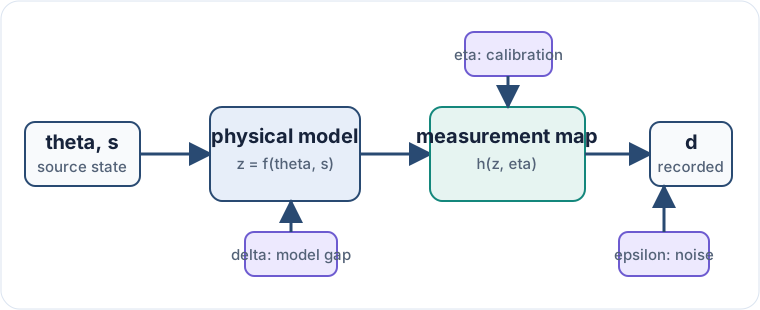
Figure 1:Model discrepancy, calibration, and measurement error can all alter recorded data. They enter different parts of the chain and cannot be exchanged without changing the scientific interpretation.
Name the model type, target observable, assumptions, parameters, state, latent quantities, and information intentionally discarded. Name one case where the model should fail.
Evaluate the mapping with explicit units and provenance. Keep preparation, runtime kernels, and measurement-model operations visible rather than hiding them behind one undifferentiated function.
Separate implementation, numerical, predictive, residual-structure, and source checks. Ask whether a discrepancy diagnoses code, numerics, data, or model inadequacy.
Continue to Linear algebra as the language of change and Models, inference, and information.