A root, interpolant, or likelihood begins as a mathematical relation. A program evaluates an approximation to that relation with finite precision, control flow, iteration counts, branch choices, and transformation rules. JAX differentiates that executed structure unless a public contract deliberately defines another derivative.
Program structure is part of the map
An if statement, minimum, sort, table-cell choice, stopping rule, or clipping
operation can change the selected branch. Smooth code within a branch does not
make the branch boundary smooth. A fixed scan gives static execution shape and
an auditable finite map; it does not turn finite iterations into an exact
mathematical solution.
JAX represents nested parameter and state structures as a PyTree. jit
stages compatible numerical work for compilation. vmap batches a function by
adding an array axis. Both preserve particular value semantics under documented
conditions; neither guarantees that expensive inactive lanes avoid all physical
work.
For an iterative relation with exact solution , a finite executed program instead exposes a finite map after steps:
The derivative on the right is the derivative of the executed finite map. It need not equal unless an additional implicit-derivative contract and its assumptions are satisfied.
Which derivative is being computed?
A smooth finite algorithm ordinarily has a pathwise derivative of its executed
operations. JAX also permits custom derivative rules: custom_jvp, custom_vjp,
and custom_root can assign derivative semantics that do not follow the primal
iteration history. A value-first iterative solver promises a converged value
and telemetry but no ideal-root derivative. Jaxstro’s implicit derivative
records caller assertions of uniqueness and smoothness, then checks numerical
convergence, finite state, residual, width, and conditioning gates before
exposing the custom-root sensitivity.
This distinction generalizes. Differentiating an interpolator at an interior point is different from differentiating the discrete selection of an interpolation cell. Differentiating a likelihood is different from validating the probability model.
Ownership boundaries
Jaxstro owns generic, dependency-light mechanics and their numerical/JAX contracts. A downstream scientific package owns domain equations, admissibility, state acceptance, retry policy, data semantics, and physical validation. An astronomy example can motivate a primitive without moving stellar, particle, or instrument policy into Jaxstro runtime logic.
Try the running case
For the two-channel measurement, suppose the parameters are found by an iterative solve. If a stopping rule, a clamp, or a selected interpolation cell changes as the measurements change, predict whether ordinary pathwise AD is differentiating an ideal solution or one selected finite program path.
Worked audit
Ordinary pathwise AD differentiates the selected finite program path. That can be exactly the desired finite-map sensitivity, but it does not by itself certify the derivative of an ideal root or of a branch-crossing model. Record the branch and solver status, then use the derivative contract matching the scientific claim.
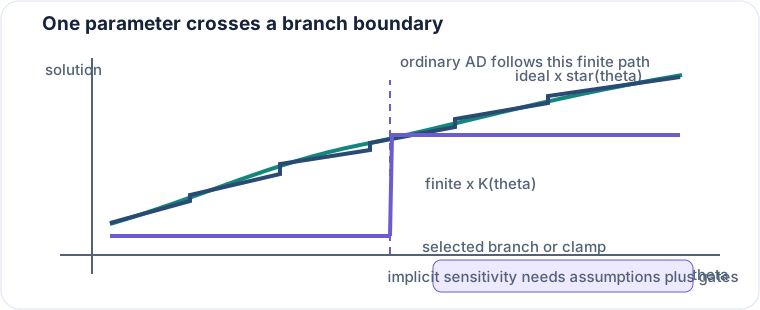
Figure 1:Finite iteration and branch selection define an executable map. A certified implicit sensitivity is a separate claim with separate assumptions and gates.
Write the ideal relation, finite algorithm, static and dynamic values, selected branches, expected transforms, and desired derivative semantics. Name where the scientific package takes ownership.
Use JAX-compatible arrays and control flow, explicit fixed shapes, typed status,
and deterministic telemetry. Apply jit, vmap, scan, JVP, or VJP only where
the public contract and domain support them.
Compare values with analytic or independent methods; inspect JAXPR when architecture matters; test JIT/VMAP parity; compare derivatives with finite differences on smooth branches; and force failure paths to verify fail-closed behavior.
For the concrete implicit-root distinction, see the
Root-finding method,
the Rootfinding public contract, and
the rootfinding