The question this method answers
Given values sampled on the Cartesian product of several ordered axes, what value should represent an interior coordinate? Regular-grid interpolation uses the surrounding cell corners, preserving any trailing payload shape.
Before computation: what should be true?
Every axis must be one-dimensional, strictly increasing, and contain at least
two points. If axis has length , the leading shape of values must be
(n_0, ..., n_{D-1}). The query’s final axis must have length . Choose
clamp, fill, or eager reject as a scientific boundary policy.
Tensor-product domains connect to Topology and discretization and axis units to Functions, units, and scales.
Define the mathematical objects
For dimension , let the axis be . A query lies in a cell whose lower corner has indices . The table value at a corner is , where . Trailing dimensions of each table entry are the payload and are not interpolation axes.
Derive the method
Normalize each coordinate inside its enclosing interval:
In one dimension, the lower and upper weights are and . Taking the product of those independent weights across dimensions gives
The weights are nonnegative and sum to one inside a cell. Consequently the interpolant reproduces constants and affine functions exactly and remains in the convex hull of scalar corner values. This rectangular-table construction is described by Weiser & Zarantonello (1988).
What the algorithm actually does
regular_grid_interp validates rank and static shapes, clips coordinates for
cell lookup, uses searchsorted on each axis, and loops in Python over the
statically known corner tuples while tracing the JAX arithmetic. Query
shape is xi.shape[:-1]; output shape is that query shape followed by
values.shape[D:].
boundary="clamp" evaluates at the nearest endpoint coordinate.
boundary="fill" replaces the complete payload if any coordinate is outside.
boundary="reject" raises for a concrete outside query. Value-dependent eager validation is skipped while axes or queries are traced, so compiled callers own that
precondition. fill_value is static under jax.jit; the boundary policy and
grid rank are static too.
bilinear_interp and trilinear_interp broadcast coordinate arrays, stack
their final query axis, and call the same generic owner.
What JAX differentiates
Table 1:Regular-grid interpolation contracts
Operation | Contract | Supported claim | Boundary |
|---|---|---|---|
Values at fixed axes and interior queries |
| AD agrees with central finite differences for table values. | The active cell is fixed locally. |
Interior query coordinates |
| AD agrees with central finite differences inside one cell. | The query remains away from grid lines and boundaries. |
Clamped or filled exterior coordinates |
| Output is locally constant in the exterior query. | Saturation or sentinel selection is not inference. |
Cell boundaries and axis locations |
| Continuity and one-sided behavior can be checked. |
|
Reject validation |
| Concrete invalid inputs can fail closed. | Value-dependent checks are skipped under tracing. |
Using it in Jaxstro
from jaxstro.jaxconfig import enable_high_precision

enable_high_precision()  # before creating JAX arrays

import jax.numpy as jnp

from jaxstro.numerics.regular_grid import bilinear_interp, regular_grid_interp

x_axis = jnp.array([0.0, 1.0, 3.0])
y_axis = jnp.array([-1.0, 2.0])
xx, yy = jnp.meshgrid(x_axis, y_axis, indexing="ij")
values = jnp.stack([3.0 * xx + yy, xx - 2.0 * yy], axis=-1)
xi = jnp.array([[0.25, 0.5], [2.5, 1.5]])

interpolated = regular_grid_interp((x_axis, y_axis), values, xi)
expected = jnp.stack(
    [3.0 * xi[:, 0] + xi[:, 1], xi[:, 0] - 2.0 * xi[:, 1]],
    axis=-1,
)
bilinear = bilinear_interp(
    x_axis, y_axis, values[..., 0], xi[:, 0], xi[:, 1]
)

outside = jnp.array([[-0.5, 0.5], [3.5, 1.0]])
clamped = regular_grid_interp(
    (x_axis, y_axis), values[..., 0], outside, boundary="clamp"
)
filled = regular_grid_interp(
    (x_axis, y_axis),
    values[..., 0],
    outside,
    boundary="fill",
    fill_value=-99.0,
)

assert jnp.allclose(interpolated, expected)
assert jnp.allclose(bilinear, expected[:, 0])
assert jnp.allclose(clamped, jnp.array([0.5, 10.0]))
assert jnp.array_equal(filled, jnp.array([-99.0, -99.0]))
How to audit the result
Verify exact values at every grid node and exact recovery of a constant and an affine payload. Within a chosen cell, compare AD coordinate and table-value gradients to central finite differences. Test every boundary policy separately, including whole-payload fill behavior and eager reject failure.
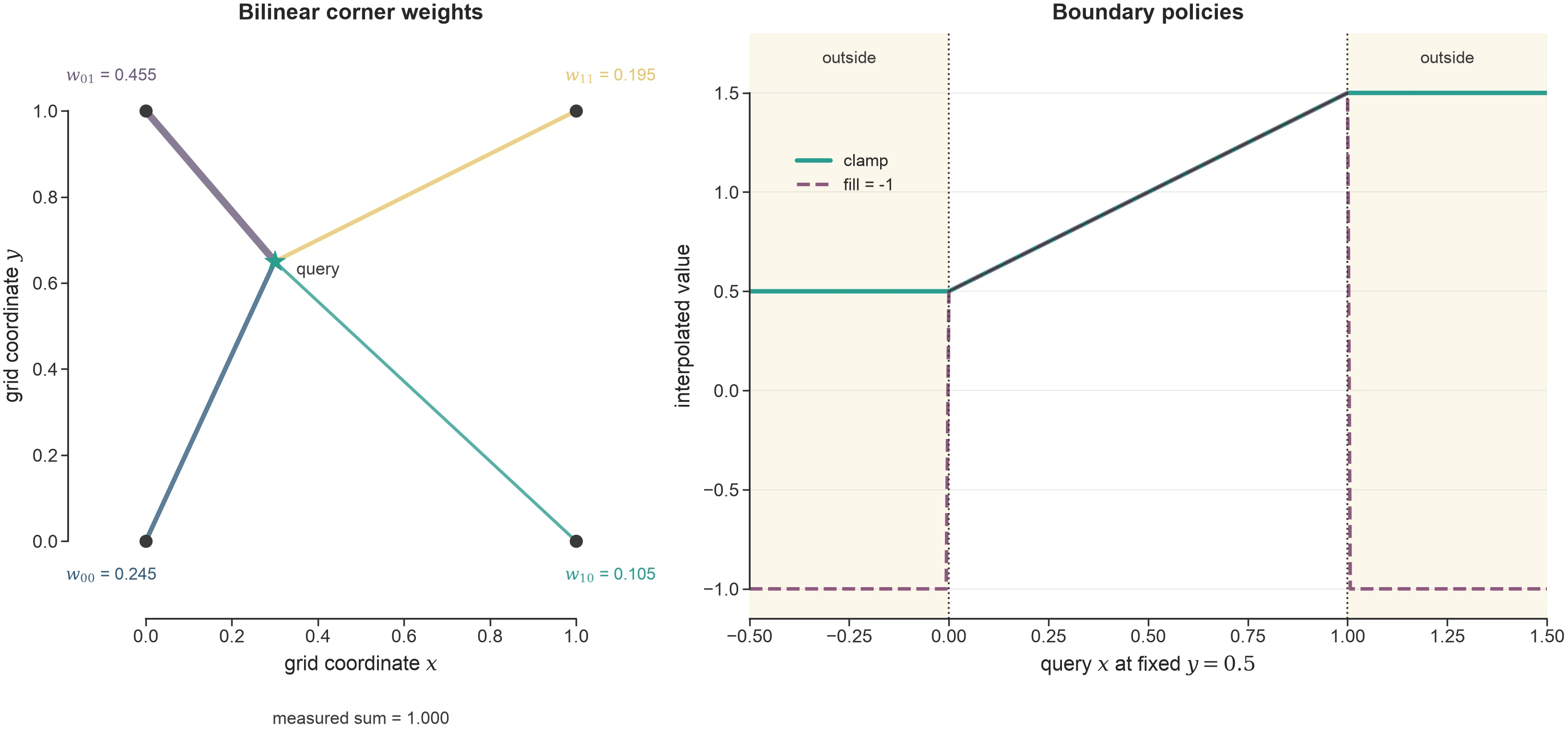
Figure 1:The measured one-hot corner weights sum to one, while the boundary panel shows the separate clamp and fill contracts. It is not a general error benchmark.
The assertion-bearing map is in Validation. Figure 1 shows the measured interior weights and the separate boundary-policy outcomes used by this audit.
Where the claim stops
This primitive does not handle scattered data, triangulations, adaptive meshes, missing-cell reconstruction, multidimensional monotonicity, or domain-specific grid selection. Exact affine recovery does not bound error for a curved function inside a coarse cell.
Connected ideas
- Weiser, A., & Zarantonello, S. E. (1988). A Note on Piecewise Linear and Multilinear Table Interpolation in Many Dimensions. Mathematics of Computation, 50(181), 189–196. 10.1090/S0025-5718-1988-0917826-0