Multimass equipartition saturation — the derived ¶
The model and the ansatz¶
In the Gieles & Zocchi (2015) (GZ15) multimass lowered-isothermal model, every mass component shares one self-consistent potential but carries its own velocity scale and anisotropy radius via power-law mass scalings (GZ15 eqs 24–26; Peuten et al. (2017) eqs 3–5):
with the central-density-weighted mean mass (GZ15 eq 26; , ). The component density rides the shared potential at the rescaled depth (GZ15 eq 29). For the traditional , is constant across bins by construction — but the model is not in energy equipartition, and the way it falls short is the physics of this page.
The honest sub-equipartition physics: why saturates¶
The observable central 1-D dispersion of component is not . In closed form (Bianchini et al. 2016 eq A1, with the paper’s missing restored — typo note):
The two limits of (2) are two different physical regimes:
Low mass — an escape-speed ceiling, not “equipartition failure”. A light component () sees the shared well at the vanishing depth : it is maximally tidally truncated, a DF cut ever closer to the escape energy (Merritt 1981). Its dispersion is therefore pinned near the central escape speed — which is a property of the shared potential and is mass-independent. Hence flattens: the local slope .
High mass — the deep-well thermalized branch. A heavy component () has : effectively an untruncated isothermal sphere, for which exactly — with , the true-equipartition (GZ15 §3.2.1), .
Both limits are verified analytically (autodiff of
(2), nothing fitted) in
scripts/validate_equipartition_saturation.py: for the 20-bin
model (, ),
–0.039 across (flat,
escape-limited end), at
(deep well, float64 noise), and is strictly monotone increasing.
The closed form itself is gated against the multimass solver’s independent
quadrature oracle: max relative difference 1.5–
(gate 10-6).
The crossover is DERIVED, not fitted¶
Bianchini et al. (2016) introduced the exponential fitting function for , above (their eq 3), with — the mass above which the cluster is in full equipartition — as the fitted “degree of equipartition”. Their Appendix A shows the crossover emerges from the GZ15 DF itself: Taylor-expanding (2) for low mass and matching linear terms (A2 ↔ A3) identifies
so is fixed by the mean mass, the truncation order , and the central concentration — not a free input. Note : more concentrated clusters reach equipartition down to lighter stars, the model-side face of Bianchini’s headline observational result that tracks dynamical age (; relaxed clusters → smaller ).
progenax validates (3) fit-free: since we hold the exact curve (2), the headline gate is the exact identity — the local saturation mass , with by autodiff, must approach the derived . Measured at (, 20 equal- log bins on ):
```{list-table} Derived-m_eq identity (scripts/validate_equipartition_saturation.py, 2026-06-11, ALL PASS; gate 0.5%).
:header-rows: 1
derived (3)
at
rel. dev.
5
0.5779
2.3114
2.3089
0.11%
7
0.6595
1.8842
1.8813
0.15%
9
0.7375
1.6388
1.6356
0.19%
::::{figure} ../../50-validation/figures/equipartition_saturation.png
:label: fig-equipartition-saturation
:width: 100%

**Fit-free equipartition saturation** across $W_0 \in \{5,7,9\}$: the exact
Engine A $\sigma(m)$ {eq}`sigma-m-closed-form` (points: quadrature oracle;
line: closed form), the derived $m_{\rm eq}$ {eq}`meq-derived` marking the
crossover, the flat escape-limited low-mass end, the deep-well $m^{-1/2}$
branch, and the dashed tangent exponential
$\sigma_0\exp(-m/2m_{\rm eq})$ illustrating the finite-window fit bias
(see the caution below).
::::

## Sharper than exponential — a caution for literature comparisons

The exponential of Bianchini eq 3 matches the DF only to **first** order. The
exact quadratic Taylor coefficient of the DF's $\sigma(m)$ — eq A2's printed
$(6+3a-4a^2)/(8a^2b^2c)\cdot\hat\phi_0^2$ term, $a=g+\tfrac52$,
$b=g+\tfrac72$, $c=g+\tfrac92$ — is **negative** for all cluster-relevant
$g$, *opposite in sign* to the exponential's $+1/(8m_{\rm eq}^2)$: the DF
saturates **sharper than exponentially**. (A3's "first terms of the Taylor
expansion of the exponential" holds for the linear term only.)

:::{admonition} Caution — fitted m_eq values are window-dependent
:class: warning
Because the true curve bends *below* the tangent exponential, an eq-3
exponential fit over a finite mass window recovers an $m_{\rm eq}$ **biased
low**, by an amount that depends on the window. Measured in a one-off
windowed-fit analysis (2026-06-11; recorded in the validation script's
docstring — the gated validation itself is deliberately fit-free): over
$\mu = m/\bar m \in [0.1/\bar m,\, 1/\bar m]$ per model — the 20-bin
$[0.1,1]\,M_\odot$ window, $\approx[0.14, 1.7]$ across the $W_0$ grid since
$\bar m$ varies — such fits recover **~0.5×** the DF-derived
{eq}`meq-derived` (0.50–0.53 across $W_0 \in \{5,7,9\}$). So when
comparing a *fitted* literature $m_{\rm eq}$ with the derived one:
**window-match first** (fit eq 3 to the model over the data's mass window), or
— future work — skip eq 3 entirely and fit the exact differentiable
$\sigma(m;\, g, W_0, \bar m)$ {eq}`sigma-m-closed-form` directly to the
kinematic data.
:::

The convergence to the identity is itself the evidence that the bias is pure
finite-mass curvature — the local saturation mass over the derived
$m_{\rm eq}$ rises monotonically to 1 as $\mu \to 0$ (printed by the script:
e.g. $W_0=7$: 0.54 at $\mu=0.5$, 0.86 at $\mu=0.1$, 0.985 at $\mu=0.01$,
0.9985 at $\mu=10^{-3}$).

## The $\bar m$ conventions, and parity with canonical LIMEPY

Three $\bar m$-related facts the bookkeeping must keep straight
([Peuten et al. 2017](../../99-bibliography/per-paper/peuten-2017.md) §2):

1. **GZ15 eq 26 (= progenax):** $\bar m$ is the **central-density-weighted**
   mean, $\bar m = \sum_j m_j\,\alpha_j$ — what Engine A's `bar_m` computes
   and what every equation on this page uses.
2. **The reference LIMEPY code's default** is the **global** mean mass
   (faster, especially with black-hole bins); it supports the GZ15 convention
   via `meanmassdef='central'`.
3. **The two describe the same physical model**, related exactly by Peuten
   eqs 8–9 (in the corrected direction — heavier reference mass ⇒ colder
   reference scale ⇒ deeper $W_0^*$):
   $W_0^{*} = W_0\,(\bar m^{*}/\bar m)^{2\delta}$,
   $\hat r_a^{*} = \hat r_a\,(\bar m^{*}/\bar m)^{\eta+\delta}$.

The parity harness (`scripts/validate_limepy_reference.py`) runs the canonical
numpy/scipy LIMEPY (repo SHA `ef2a479`, pinned ephemeral env, outputs cached
with provenance) with `meanmassdef='central'`, so both codes share one
$(W_0, \bar m)$ convention and no eq 8–9 translation is needed. Six configs —
single-mass $g=1$ (King) and $g=1.5$; 2-component $\delta=0.5$; the 4-bin
Maschberger IMF ($\delta=0.4$); and the 2-component anisotropic pair
$\hat r_a = 5$, $\eta \in \{0, 0.5\}$ — compared on scale-invariant
quantities only:

```{list-table} Ours-vs-reference-LIMEPY parity (2026-06-11, ALL PASS; worst case across the 6 configs, per quantity).
:header-rows: 1

* - Quantity (scale-invariant)
  - worst measured
  - gate
* - density shape $\max|\Delta[\rho_j(r)/\rho_j(0)]|$
  - $1.3\times10^{-5}$
  - $2$–$5\times10^{-5}$
* - dispersion shape $\max|\Delta[\sigma_j(r)/\sigma_j(0)]|$
  - $8.4\times10^{-5}$
  - $2\times10^{-5}$–$3\times10^{-4}$
* - central density fractions $\max|\Delta\alpha_j|$
  - $4.9\times10^{-5}$
  - $10^{-8}$–$5\times10^{-4}$
* - realized mass fractions $\max|\Delta M_j/M|$
  - $7.1\times10^{-5}$
  - $10^{-8}$–$5\times10^{-4}$
* - concentration $|\Delta\log_{10}(r_t/r_0)|$
  - $1.5\times10^{-4}$
  - $5\times10^{-4}$
* - half-mass radius $|\Delta r_h|/r_h$
  - $6.3\times10^{-6}$
  - $10^{-4}$
All scale-invariant quantities agree to — Engine A
is a faithful (and differentiable) reimplementation of the published model.
Gates were measured first, then frozen with honest headroom (~3–10× the
measured deviations); the skip-if-absent regression test is
tests/validation/test_limepy_reference_parity.py.
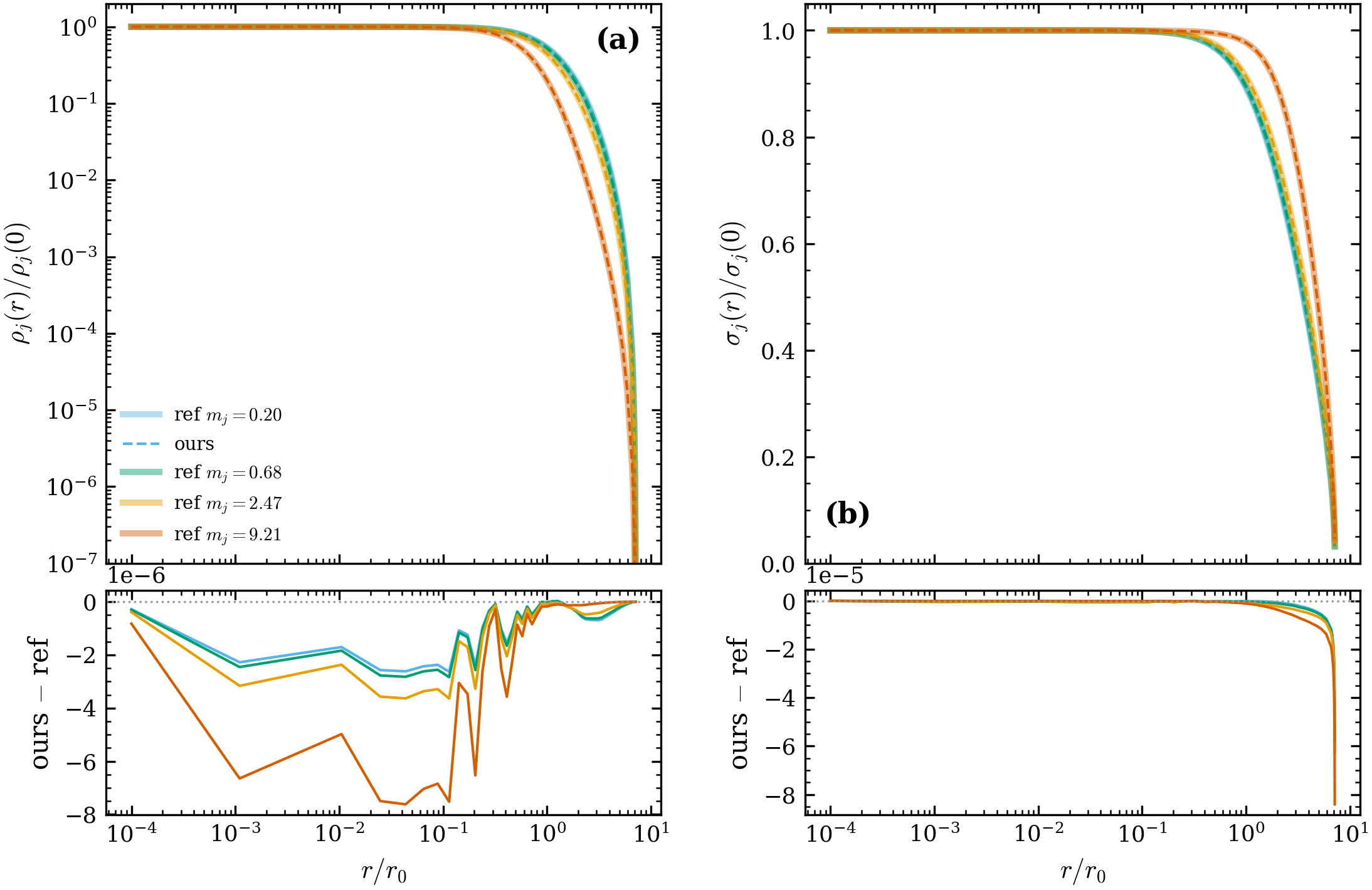
Figure 1:Reference parity for the representative multimass config: per-component and , ours (curves) vs canonical LIMEPY (points), with residual strips.
What is deliberately NOT here: meq and zeta¶
The published LIMEPY code carries two extra knobs absent from the GZ15 and
Peuten et al. (2017) equations: meq (a low-mass softening
, whose docstring citation of “GZ15 eq 24”
is incorrect — eq 24 is the pure power law) and zeta (a high-mass
decoupling motivated by the Spitzer instability). Both are deferred in
progenax (decision 2026-06-11): they are fitting freedom, not the
saturation mechanism — as this page shows, the standard model already
saturates, with the crossover (3) set by .
If a future fit needs to decouple the equipartition degree from
(meq) or model a dark-remnant subsystem (zeta), they will be added as
default-off kwargs and documented honestly as code heuristics, not
published equations.
Reproduce¶
env -u VIRTUAL_ENV uv run --no-sync python scripts/validate_limepy_reference.py
env -u VIRTUAL_ENV uv run --no-sync python scripts/validate_equipartition_saturation.py
Implementation, validation & references¶
In code:
src/progenax/cluster/multicomponent.py— the standard Engine A multimass model (bar_m, the closed-form , andcomponent_virial_ratios); no new code or parameter is introduced for this page. See theMultiComponentClusterAPI.Validated in: multimass equilibrium; the fit-free saturation and reference-LIMEPY parity gates are reproduced by the scripts in the Reproduce block above (
scripts/validate_equipartition_saturation.py,scripts/validate_limepy_reference.py).Primary sources: Gieles & Zocchi (2015) (the multimass DF and ansatz, eqs 24–29); Peuten et al. (2017) (multimass methods + -convention translation, eqs 3–5, 8–9); Bianchini et al. (2016) (the relation, its Appendix-A derivation, and the –dynamical-age relation). Full notes in the bibliography: Gieles & Zocchi 2015 · Peuten et al. 2017 · Bianchini et al. 2016.
- Gieles, M., & Zocchi, A. (2015). A family of lowered isothermal models. Monthly Notices of the Royal Astronomical Society, 454, 576–592. 10.1093/mnras/stv1848
- Peuten, M., Zocchi, A., Gieles, M., Gualandris, A., & Hénault-Brunet, V. (2017). Testing lowered isothermal models with direct N-body simulations of globular clusters – II. Multimass models. Monthly Notices of the Royal Astronomical Society, 470, 2736–2761. 10.1093/mnras/stx1311
- Bianchini, P., van de Ven, G., Norris, M. A., Schinnerer, E., & Varri, A. L. (2016). A novel look at energy equipartition in globular clusters. Monthly Notices of the Royal Astronomical Society, 458, 3644–3654. 10.1093/mnras/stw552