Use this page when an array of spectral values must retain its coordinate, sampling, density semantic, provenance, and interpolation boundary before it enters a compiled calculation.
Representation contract
| Contract field | Current representation |
|---|---|
| Mathematical object | A one-dimensional Spectrum pairs values with a SpectralAxis, SpectralSemantic, mandatory SpectrumProvenance, and structured status. |
| Physical convention | The spectral coordinate, unit, point or bin sampling, and density semantic are explicit; canonical atmosphere preparation uses increasing wavelength in nm and named CGS density units. |
| Runtime owner | jaxstro.spectra owns generic types and array operations; jaxstro.atmospheres owns host-side source preparation. |
| Shape and unit policy | Axis values and spectrum values are one-dimensional and shape-matched; prepared topology arrays have fixed shapes, while units and semantics are static metadata. |
| Transform boundary | Prepared array evaluation supports jit, vmap, and local pathwise AD inside a fixed topology; lookup, artifact I/O, topology selection, and policy choice remain host-side. |
| Evidence | Spectra unit and validation tests cover semantic transforms, fail-closed resampling, prepared stencils, AD-vs-FD, artifacts, and policy manifests. |
| Downstream interpretation boundary | Filters, extinction, instruments, distance and radius policy, detector counts, images, likelihoods, and model validity remain downstream. |
Why a spectrum is more than an array
A wavelength density and a frequency density represent different derivatives of the same flux. For point-sampled values they satisfy
Changing only the coordinate values would violate the density relation in
(1). to_flux_lambda and to_flux_nu transform the
axis, values, semantic, and provenance together. These transforms currently require
point samples and canonical nm or Hz axes.
Point samples, bin averages, and bin integrals are also distinct. A point sample is a
value at one coordinate. A binned value represents an interval and therefore requires
edges. SpectralAxis.sampling makes that distinction explicit.
Host preparation and runtime evaluation
jaxstro.atmospheres owns the host-side request:
AtmosphereQuery -> PreparationResult[PreparedAtmosphere]Interface notation, not Python
jaxstro.spectra owns the fixed-shape array surface. Fluxax keeps ownership of
extinction, filters, instruments, counts, magnitudes, PSFs, images, and
likelihood-facing observables.
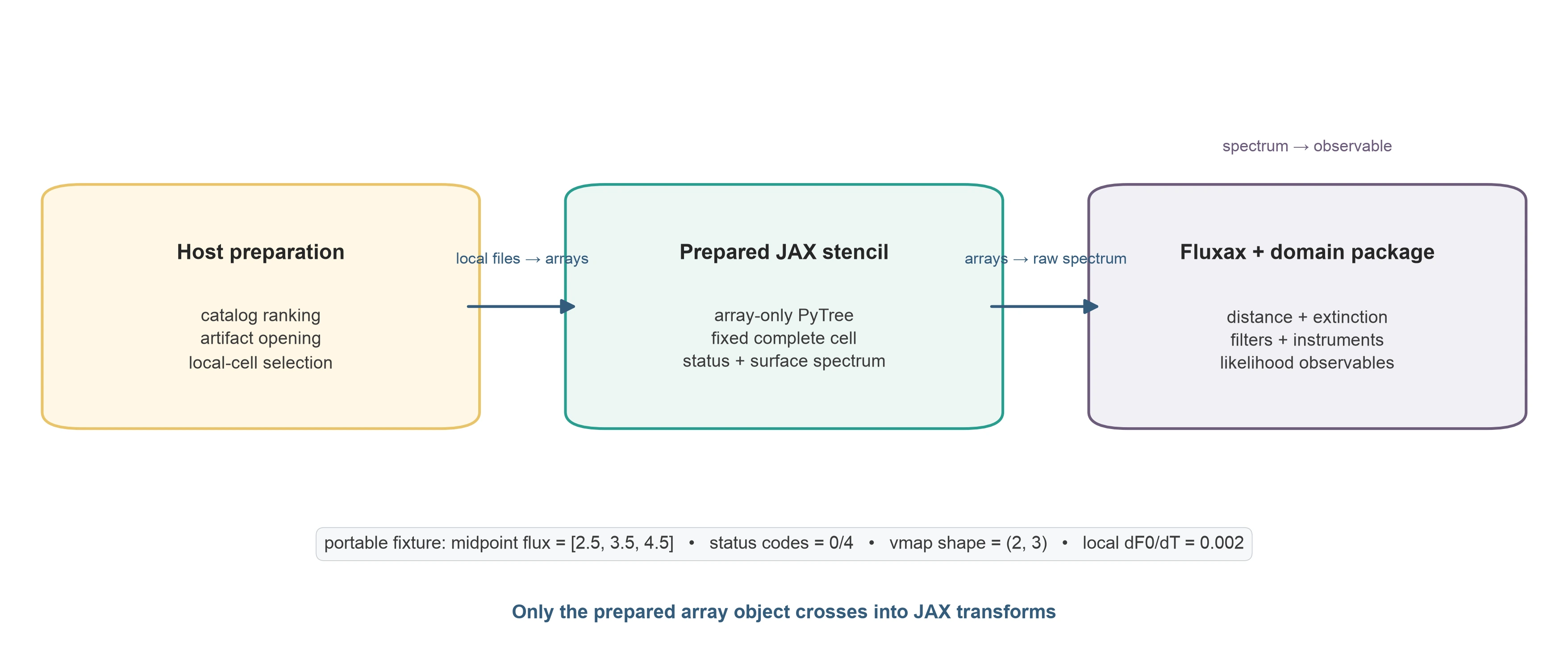
Figure 1:The filesystem boundary is one-way. Host code selects an exact product and complete local topology, converts vertices to one requested spectral axis, and returns a fixed-shape PyTree. Evaluation then uses arrays only.
Figure 1 identifies the host/runtime handoff that the execution-boundary table formalizes.
Table 1:Spectra execution and ownership boundaries
Operation | Execution side | Owner and contract |
|---|---|---|
Product lookup and topology selection | Host-side Python |
|
Spectral conversion and preparation | Host-side Python with optional data dependencies | Each source vertex is converted to increasing wavelength in |
Prepared parameter interpolation | JAX-side array computation |
|
Observable rendering | Downstream package | Fluxax and domain packages own distance scaling, attenuation, passbands, detector response, images, and likelihood semantics. |
Portable JAX-side example
This complete example creates a prepared cell in memory. It requires no local atmosphere artifacts.
import jax
import jax.numpy as jnp

from jaxstro.spectra import (
    FluxInterpolation,
    PreparedRectilinearStencil,
    SpectralAxis,
    SpectralCoordinate,
    SpectralSemantic,
    Spectrum,
    SpectrumProvenance,
    SpectrumStatusCode,
)

axis = SpectralAxis.points(
    jnp.array([500.0, 600.0, 700.0]),
    coordinate=SpectralCoordinate.WAVELENGTH,
    unit="nm",
)
template = Spectrum(
    axis=axis,
    values=jnp.array([1.0, 2.0, 3.0]),
    semantic=SpectralSemantic.SURFACE_FLUX_LAMBDA,
    provenance=SpectrumProvenance(
        source_id="portable-fixture",
        product_id="portable-fixture",
        native_coordinate="wavelength_nm",
        native_density="F_lambda",
        native_unit="erg s^-1 cm^-2 nm^-1",
        canonical_conversion="identity",
        citations=("fixture:documentation",),
    ),
)
prepared = PreparedRectilinearStencil(
    parameter_axes=(jnp.array([5000.0, 6000.0]), jnp.array([4.0, 5.0])),
    vertex_values=jnp.array(
        [
            [[1.0, 2.0, 3.0], [2.0, 3.0, 4.0]],
            [[3.0, 4.0, 5.0], [4.0, 5.0, 6.0]],
        ]
    ),
    template=template,
    interpolation=FluxInterpolation.LINEAR,
)

midpoint = prepared.evaluate(jnp.array([5500.0, 4.5]))
outside = prepared.evaluate(jnp.array([4500.0, 4.5]))

@jax.jit
def first_flux(teff):
    return prepared.evaluate(jnp.array([teff, 4.0])).spectrum.values[0]

local_slope = jax.grad(first_flux)(5500.0)

assert jnp.allclose(midpoint.spectrum.values, jnp.array([2.5, 3.5, 4.5]))
assert int(midpoint.status.code) == SpectrumStatusCode.OK
assert int(outside.status.code) == SpectrumStatusCode.OUTSIDE_CONVEX_HULL
assert jnp.all(jnp.isnan(outside.spectrum.values))
assert jnp.isclose(local_slope, 0.002)
The derivative is local to one fixed cell. Catalog ranking, artifact I/O, topology changes, and interpolation-policy selection are discrete host operations and are not advertised as differentiable.
Query a local atmosphere library
Execution contract - local processed artifacts required. This recipe also
requires the data optional dependencies.
import jax.numpy as jnp

from jaxstro.atmospheres import AtmosphereLibrary, AtmosphereParams, AtmosphereQuery
from jaxstro.spectra import SpectralAxis, SpectralCoordinate, SpectralPlan

library = AtmosphereLibrary.from_local("data")
query = AtmosphereQuery(
    params=AtmosphereParams(teff=5772.0, logg=4.44),
    product_id="newera-v3-lowres",
    family="newera",
    spectral_plan=SpectralPlan(
        SpectralAxis.points(
            jnp.linspace(500.0, 2500.0, 256),
            coordinate=SpectralCoordinate.WAVELENGTH,
            unit="nm",
        )
    ),
    requested_parameter_names=("teff", "logg"),
)
preparation = library.prepare(query)
if preparation.prepared is not None:
    result = preparation.prepared.evaluate(query.params)
Expected scientific gaps return a SpectrumStatusCode. Corrupt artifacts and broken
invariants raise exceptions instead of masquerading as coverage gaps.
Current evidence boundary
Real-artifact holdouts currently accept positive-log parameter interpolation for
NewEra and linear interpolation for the BOSZ resampled product and OSTAR2002. Sonora Diamondback and both BSTAR modes remain POLICY_NOT_VALIDATED: their measured linear
and positive-log errors trade off under the declared selection rule. The adapters and
artifacts exist, but AtmosphereLibrary.prepare(...) refuses to present those paths
as supported science.
See Atmosphere libraries and coverage, Query atmosphere spectra, and Validation for the product, workflow, and evidence boundaries.