The question this method answers
A Lagrangian mesh follows the mass: each cell keeps its mass, and its faces move with the fluid. The resolution a simulation needs moves too. A collapsing cloud needs cells at an accretion shock that sweeps through the mass coordinate; a star needs cells where a burning shell or a convective boundary sits. How can a researcher add cells where they are needed and remove them where they are not, without disturbing the cells that need no change, without losing conservation, and without breaking the gradient of the run?
jaxstro.numerics.lagrangian_remap answers this for one dimension. It owns the
operation only: which cells are split or merged is decided by the caller’s criterion
(a shock sensor in hydrax, MESA’s mesh functions in stellax).
Before computation: what should be true?
The mesh carries all faces, ordered centre-out, in a coordinate in which cell volume is linear: in spherical symmetry, in slab symmetry.
Cell masses and every conserved field given as a cell total (momentum, energy, species mass), not as a density or a specific value.
The caller decides which cells to split or merge and how often. A split adds no information: the children inherit the parent’s content, shared by a reconstruction. It adds the ability to represent structure that the dynamics will create next.
Define the mathematical objects
Half cells. Old cell is cut at its half-mass point into an inner half cell and an outer half cell , each of mass . A new cell is a contiguous run of half cells. Its boundaries therefore lie on old faces or on old half-mass points, which is MESA’s rule (at most two subcells per old cell).
Plan. A RemapPlan lists, for each new slot, the first half cell (start) and the
number of half cells (length): a kept cell is a run of 2 starting on an even index, a
split child is a run of 1, a merge of two whole cells is a run of 4. Runs tile the old
mesh in order. The plan is integer data with a static capacity. A plan built with
subcells=4 cuts every old cell into four equal-mass parts instead, so a half cell can be
halved again; MESA’s surface pass needs this once in about 230,000 faces of a 1 Msun
pre-main-sequence to TAMS run (stellax, 2026-10-03). Sub-cell of holds
, which is the formula below for .
Derive the method
Let the specific value be reconstructed linearly in mass across cell , , with the cell’s mass centre. The inner half covers , so its content is
The outer half is formed as the difference, so the halves sum to the parent to rounding. With the share is equal and the children carry the parent’s specific value, which is MESA’s rule for a split. The half-mass face uses the same formula with and , the slope of the specific extent (the specific volume up to the geometry constant).
A new cell’s content is the sum of its half cells. When the run starts and ends on old faces it is computed instead as the sum of the old totals, so a one-cell run is the old value itself (a gather, bitwise) and a two-cell merge is .
Slopes. limited_slopes uses the monotonised-central limiter in mass,
, zero in the end cells and where the
one-sided slopes differ in sign. The half-cell mean is ,
and ,
so each child’s mean lies between the neighbouring means and a positive specific value
stays positive. For mass fractions, joint=True scales every component’s central slope
by one factor per cell, so the slopes sum to zero and the children keep
.
Predicted accuracy. Take a smooth monotone on a uniform mesh of spacing . Expanding about the cell centre, the cell mean is and the inner half-cell mean is . Piecewise-constant reconstruction gives the cell mean to both children, an error of : first order. The central slope of the cell means is , so the linear rule’s child mean is . The terms agree, and the error is : third order.
What the algorithm actually does
Public callables
Callable | Role |
|---|---|
| per-cell |
| equal numbers of splits and merges, so is unchanged |
| MC slopes of a specific value in mass |
| the transfer: faces, masses and every leaf of a PyTree of totals |
| the record; |
fixed_count_plan marks a cell as a split candidate when its score exceeds a threshold
and a neighbour pair as a merge candidate when its score is below a second, lower
threshold (hysteresis), excluding pairs that touch a split candidate. A pair is kept
only if its score is a strict local minimum among the overlapping pairs, ordered by
score and then by index; two overlapping pairs cannot both pass, so the merges are
disjoint without a sequential walk. It then applies the strongest splits and the
weakest merges, with the smaller candidate count bounded by a static max_changes.
Optional masks exclude cells (a sink cell, a pinned face), and an optional cell-ratio
limit (MESA uses 2.5) forces a split of a cell larger than that ratio times a neighbour
and blocks a merge that would create one.
A caller with its own planner builds a RemapPlan directly; stellax’s port of MESA’s
surface-to-centre walk is that case. A padded capacity larger than the cell count is
allowed: empty slots have zero mass and repeat the outer face.
Measured accuracy
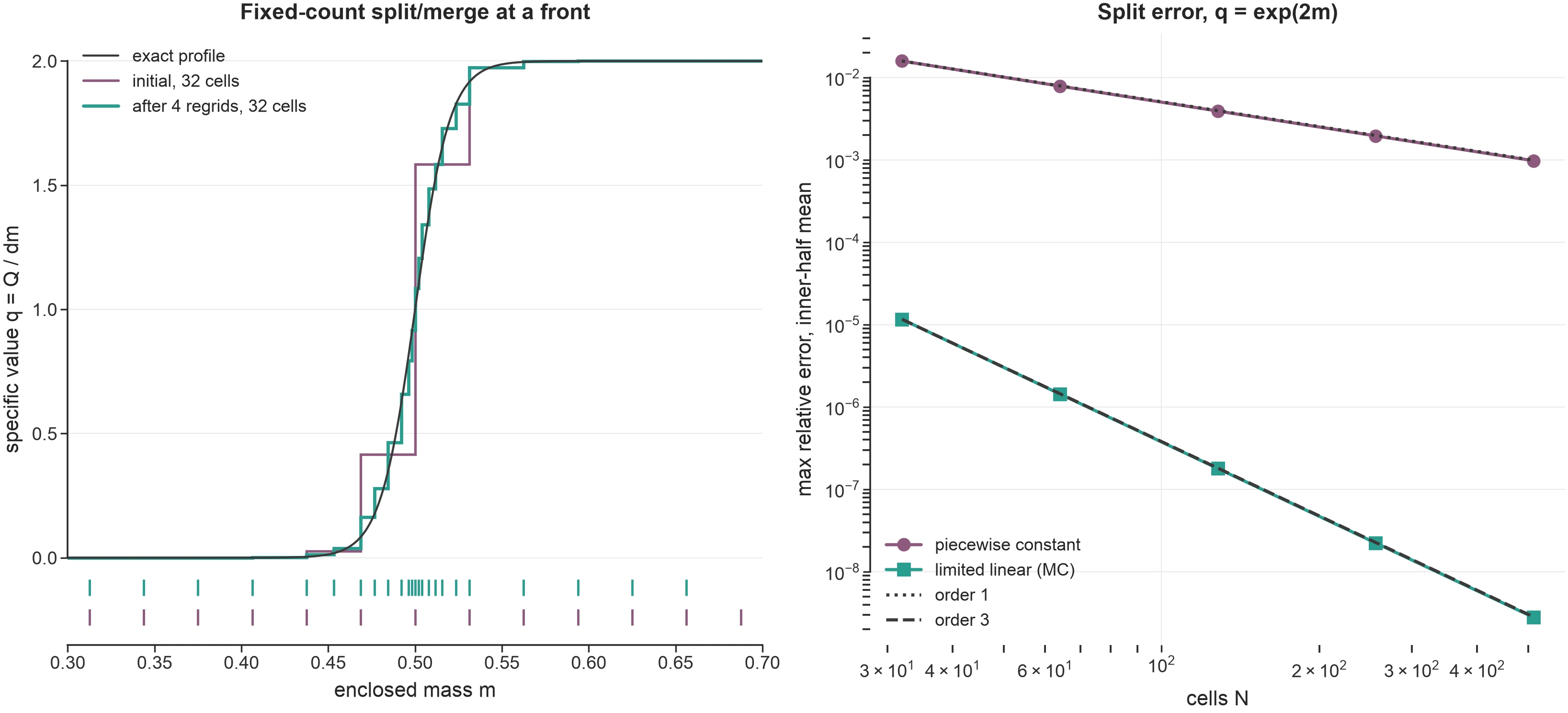
Figure 1:Left: a front on 32 uniform-mass cells (slab,
unit density), after four passes of fixed_count_plan (split above a neighbour jump of
0.1, merge below 0.02, at most 4 changes per pass, ratio limit 2.5). The cell count
stays 32; the face ticks show the cells moving to the front. Right: maximum relative
error of the inner child’s mean for when every cell is split, interior
cells.
Split error for q = exp(2m), every cell split, interior cells (measured 2026-10-03)
Cells | piecewise constant, max rel. error | order | limited linear, max rel. error | order |
|---|---|---|---|---|
32 | 1.59e-2 | 1.16e-5 | ||
64 | 7.87e-3 | 1.011 | 1.44e-6 | 3.012 |
128 | 3.92e-3 | 1.006 | 1.80e-7 | 3.006 |
256 | 1.96e-3 | 1.003 | 2.24e-8 | 3.003 |
512 | 9.78e-4 | 1.001 | 2.80e-9 | 3.001 |
Figure 1 shows both effects: cells gathering at a front at fixed
count, and the split error falling at the predicted orders. Both orders match the
prediction above. The half-mass face position converges at
1.000 and 3.000. Conservation of mass, extent and every field holds to 10-14
relative on a random non-uniform mesh with splits and merges; the transfer’s AD
derivative matches central differences to relative
(tests/validation/test_lagrangian_remap_order.py).
What JAX differentiates
The plan is integers and has no derivative. The decision to split or merge is a
discrete event: perturbing the inputs can flip it, and no smooth derivative exists
across that flip. A gradient through a run that regrids is the derivative at fixed
topology: record each plan in the forward pass and replay the same plans
(the frozen hierarchy). apply_plan is then a fixed composition of gathers, sums and
products, smooth in the faces, the masses and the fields. limited_slopes is
piecewise smooth; selections use jnp.where, so at a limiter switch the whole
derivative goes to the selected branch. Every loop is static (max_length is at most
4), so the transfer runs inside a lax.scan step.
Using it in Jaxstro
import jax.numpy as jnp

from jaxstro.numerics import lagrangian_remap as lr

xi_face = jnp.linspace(0.0, 1.0, 9) ** 3          # spherical: xi = r**3
dm = jnp.full(8, 0.125)
energy = dm * jnp.array([1.0, 1.0, 1.0, 4.0, 9.0, 9.0, 9.0, 9.0])

q = energy / dm
jump = jnp.abs(jnp.diff(q))
split_score = jnp.concatenate([jump[:1], jnp.maximum(jump[:-1], jump[1:]), jump[-1:]])
merge_score = jump + jnp.concatenate([jump[1:], jnp.zeros(1)])
plan = lr.fixed_count_plan(split_score, merge_score, 2.0, 0.5, max_changes=2)

xi_new, dm_new, energy_new = lr.apply_plan(
    plan, xi_face, dm, energy, lr.limited_slopes(q, dm),
    lr.limited_slopes(jnp.diff(xi_face) / dm, dm),
)
assert jnp.allclose(jnp.sum(energy_new), jnp.sum(energy), rtol=1e-14)
assert dm_new.shape == dm.shape
assert bool(plan.is_valid(8))
How to audit the result
Check
plan.is_valid(n_old)andplan.n_active <= plan.capacitybefore applying a plan built by hand.Check that the cells the plan keeps are bitwise equal to their old values (
plan.is_copy), faces included.Check the totals of mass, extent and every field to rounding, and the outer face exactly.
For a field that must stay positive, check the children; with independent limiting check the sum of mass fractions, or use
joint=True.For a gradient, record the plans and replay them, and compare AD with central differences at fixed plans; an FD step that flips a plan is not a valid reference.
Where the claim stops
One dimension only. Multi-dimensional refinement needs a block or tree hierarchy and is not provided.
A split cuts a cell at its half-mass point only; a cell can be split into at most two per regrid, and repeated regrids refine further.
No refinement criterion, no equation of state, no field semantics. Quantities that are not linear in the transferred totals (temperature from internal energy, kinetic energy from momentum) are the caller’s: a split shares momentum and total energy with the same mass fraction under piecewise-constant reconstruction, so each child keeps its parent’s velocity and specific internal energy, but a limited-linear momentum share changes the kinetic energy and must be paired with an energy rule by the caller.
Potential-energy changes from moving mass in a gravitational field are not corrected (MESA caps them at 5 %; stellax applies its own correction).